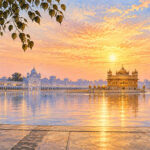
Nearly four and a half centuries ago, amidst the fields of Panjab, something profound began to unfold—not of worldly power, but of Divine Presence. A sanctuary not to place the One above, but to recognize the One within and among us. A space open to all, regardless of caste, creed, or custom. A sanctuary born of Sabad, shaped by humility, and sustained by love: Sri Harimandar Sahib.
This was not a spontaneous construction—it was a carefully envisioned unfolding during the Guruships of Guru Nanak Sahib’s third, fourth, and fifth Embodiments: Guru Amardas Sahib, Guru Ramdas Sahib, and Guru Arjan Sahib. Guru Amardas Sahib acquired the land. Guru Ramdas Sahib initiated the excavation of the sarovar (pool) and the layout of the emerging township, then known as Chak Guru or Guru Ka Chak, later renamed Ramdaspur. Guru Arjan Sahib completed the construction of the Harimandar and formalized it as the nucleus of the Sikhs as well as humanity.
![Sikh Research Institute [File Photo]](https://sikhsiyasatnews.net/wp-content/uploads/2024/11/Sikh-Research-Institute1.jpg)
This was no palace. No towering spire marked its claim. Instead, the Harimandar was placed lower than the surrounding area, drawing all into humility. Its four doors welcomed all directions, all people. It rose from the center of the Amrit-sar—the Pool of Immortality—not merely as a structure of beauty, but as an institution of the Wisdom’s dwelling on Earth.
The name itself speaks volumes. Hari, the 1-Light; mandar, a dwelling. In the Guru Granth Sahib, Harimandar refers not only to a physical space, but to the inner sanctum of the seeker. Guru Amardas Sahib reveals: “With the Guru’s grace, the Harimandar is seen within… Harimandar is to be searched in Sabad.” The Harimandar outside was built to mirror the Harimandar within. One cannot be separated from the other.

However, the vision did not end there. Across the sarovar, a seat of divine authority arose—Akal Takht Sahib, the Timeless Sovereign Throne. Guru Harigobind Sahib laid the foundation, elevating the Sikh Nation with the principle of Miri-Piri—the political-spiritual. While Sri Harimandar Sahib called the seeker inward, Akal Takht Sahib awakened the initiated outward. One offered sanctuary; the other offered strength. Together, they embodied the Sikh ideal: that devotion and dignity walk hand in hand, that justice and humility are not opposites, but companions. That’s the political-spiritual!
Around these sanctuaries of wisdom and sovereignty, a city grew—Ramdaspur, now Amritsar. More than a settlement, it became a fellowship—a gathering of seekers, a sanctuary of learning, where Nam, Sabad, and Seva took on living form. The sarovar became more than water—it became a way of being.
As we reflect on the centuries since its foundation, we are not merely remembering a place—we are being drawn into its presence. Sri Harimandar Sahib continues to shine as a sanctuary of love and learning, of humility and sovereignty. It invites each of us to turn inward, to build the Harimandar within, where Nam flows and Sabad illuminates. Are we immersing in that inner sarovar? Are we living the values that first shaped its waters and its welcome, its open doors and open hearts? The call of Harimandar is timeless, rooted in the then, alive in the now.
This is not a celebration of stone or gold. It is a remembrance of vision. A recommitment to the Wisdom-Guru. A reaffirmation that the 1-Light’s Mansion was—and still is—meant for all. It became a Darbar, the Divine’s Court!
May we arrive at the Harimandar and the Takht—not just in place, but in presence.
May our lives reflect the sanctuary and the strength.
May the Wisdom-Guru guide us!