Parmjeet Singh Gazi
The unresolved issue of the Sikh Reference Library has once again come to the forefront of discourse. On March 12, 2026, Rajya Sabha MP Satnam Singh Sandhu raised the matter during Question Hour in the Indian Parliament. He highlighted the historical significance of the library and demanded the restoration of its rare Sikh manuscripts and handwritten saroops (scriptures).
In response, Union Minister of Culture Gajendra Singh Shekhawat termed the damage caused to the library a deeply ‘unfortunate incident’. He said that the Union government, under the ‘Gyan Bharatam Mission’, would explore possibilities to digitally restore the damaged Sikh literature and hold further discussions with the MP to take the initiative forward.
The response of Sikh organizations to this announcement is highly anticipated, especially given the deep-seated distrust between the Sikhs and the Central Government of India. Many within Sikh circles have long maintained that the Sikh Reference Library was systematically looted with the intent to confiscate and potentially manipulate historical Sikh artifacts and sacred writings.
A Treasure Trove of Sikh History
The foundation of this irreplaceable institution dates back to February 10, 1945, during a gathering of prominent scholars at Khalsa College, Amritsar. This pivotal meeting was spearheaded by Princess Bamba Sutherland—the eldest daughter of Maharaja Duleep Singh and the last surviving member of the Sikh Empire’s royal family. Under her visionary leadership as the honorary president of the newly formed Sikh Historical Society, the “Central Sikh Library” was established at Khalsa College.
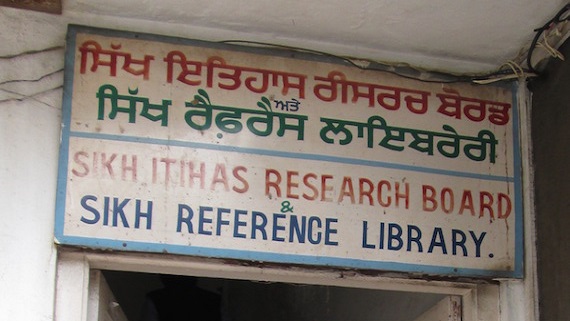
On October 27, 1946, the Shiromani Gurdwara Parbandhak Committee (SGPC) officially passed a resolution to integrate this collection into the newly minted “Sikh Reference Library.” Initially operating out of Guru Ram Das Niwas, the library and its rapidly growing archives were eventually shifted to a dedicated, newly constructed building within the sacred Sri Darbar Sahib complex in 1953.
It was the institutional memory and the spiritual repository of the Sikhs. Prior to 1984, it housed an estimated 20,000 literary works, including over 12,000 rare books and around 2,500 priceless manuscripts. Its archives preserved hand-written saroops of Sri Guru Granth Sahib—including the revered Damdami Bir—as well as 20 to 25 handwritten hukamnamas (edicts) bearing the actual signatures of the Sikh Gurus. The library also documented the region’s broader history, containing unparalleled artifacts and literature chronicling the Sikh journey from the era of Guru Nanak Dev Ji onwards.
Libricide and the Destruction in June 1984
The attack on around 70 Sikh Gurdwaras by the Indian Army in June 1984 was codenamed by the Indian State and Indian Army as “Operation Blue Star“, but Sikhs regard it as a Teeja Ghallughara (third holocaust). During the Ghallughara June 1984 the building of Sri Akal Takht Sahib was massively damaged by tank fire. However, the tragedy extended beyond the loss of human life and physical infrastructure into the realm of libricide—the deliberate and systematic destruction of a people’s knowledge, history, and cultural identity.
The Indian Army’s official white paper claimed the library caught fire during an exchange of gunfire on June 5. However, this narrative is fiercely contested by the community. According to the library’s in-charge at the time, Devinder Singh Duggal, and former SGPC secretary Manjit Singh Calcutta, the library was entirely intact until the evening of June 6, after the primary fighting had ended. Eyewitness accounts and subsequent disclosures from former CBI insiders revealed that the state apparatus meticulously scrutinized the historical manuscripts, packed them into numbered gunny sacks, and transported them away in military vehicles to temporary offices in Amritsar. It was only on June 7, after the invaluable literature was looted, that the empty library was deliberately set ablaze. For the Sikh people, this was a calculated act of libricide designed to erase their historical footprint and sever their connection to their roots.
A Decades-Long Struggle by Sikh Bodies
In the decades following the Ghallughara June 1984, Sikh organizations, primarily the Shiromani Gurdwara Parbandhak Committee (SGPC), along with numerous scholars and political leaders, have relentlessly kept the issue alive. They have continuously campaigned for the return of the stolen intellectual and spiritual heritage. Through endless correspondence, resolutions, and legal avenues—including a 2004 Punjab and Haryana High Court order directing the Central Bureau of Investigation and the government to return the seized materials—Sikh bodies have tirelessly demanded accountability and the repatriation of their sacred texts.
Empty Assurances
Despite these unyielding efforts, the struggle has been met with contradictory statements and unfulfilled promises. Various central governments have offered assurances at different times, yet nothing concrete has ever materialized.
Over the years, state agencies have oscillating claimed that all materials were burnt to ashes, or that the items were already returned to the SGPC.
Tragically, the SGPC has also drawn criticism from within Sikh circles for its handling of the matter, having failed to publish a transparent, definitive inventory that could put these contentious ‘return’ claims to rest once and for all.
A Cautious Wait: High-Tech Assurances and Enduring Distrust
While the recent parliamentary exchange regarding AI restoration brings the topic back to the discussion stage, the Sikh community remains deeply sceptical. For over forty years, empty assurances have failed to heal the open wound of a stolen heritage.
While it is imperative that the surviving manuscripts, hukamnamas, and holy saroops are transparently accounted for and respectfully returned to the Khalsa Panth, the libricide of the Sikh Reference Library will forever stand as an enduring symbol of a systemic campaign to eradicate the foundational sources of Sikh epistemology.