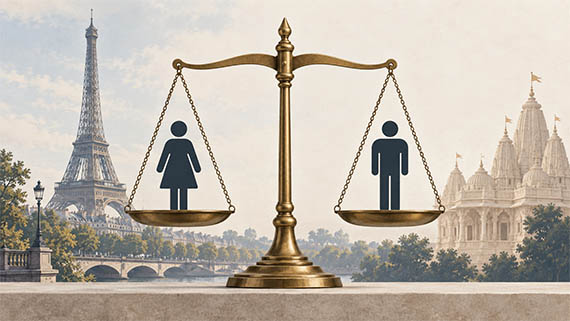
LONDON — The reported exclusion of female staff at the Eiffel Tower during a private tour for a Hindu religious delegation has sparked serious concern and wider scrutiny regarding the organisation’s treatment of women.
The controversy began on Saturday, September 5, when a delegation of around 100 people linked to the Bochasanwasi Akshar Purushottam Swaminarayan Sanstha (BAPS) visited the Eiffel Tower. The group was in France ahead of the consecration of the organisation’s first major traditional Hindu temple near Paris, which took place on Sunday. Indian Prime Minister Narendra Modi addressed the gathering via video link, hailing the temple as a milestone for India-France cultural ties.

During the delegation’s visit to the Parisian landmark, female employees were reportedly instructed to leave their workstations and were replaced by male colleagues. The incident led to a staff strike that forced the temporary closure of the monument on Monday.
Société d’Exploitation de la tour Eiffel (SETE), the company that operates the tower, acknowledged that the BAPS delegation had requested “limited interactions with women,” and admitted that such conditions should not have been accepted. The incident drew immediate condemnation across France. Paris Mayor Emmanuel Grégoire stated that equality between men and women “will never stop at the foot of our historical monuments,” and confirmed that an investigation would be launched. French Gender Equality Minister Aurore Bergé and former Prime Minister Gabriel Attal also strongly denounced the sidelining of female workers, affirming that no belief or culture can dictate a woman’s place in France.
The Sikh Federation (UK) has highlighted that the episode prompts broader questions about the representation and rights of women within the BAPS organisation.
Dabinderjit Singh OBE, Chief Executive for Political Engagement at the Sikh Federation (UK), said:
“The investigation that has been launched must establish whether any pressure was applied to exclude female staff. If so, that would be completely unacceptable and heads should roll.
“The absence of women from the BAPS delegation has also intensified scrutiny of the organisation. While that alone does not prove discrimination, it has raised legitimate questions about the visibility, leadership and influence of women within BAPS.”
Contrasting the incident with Sikh principles, Singh added:
“A core principle of Sikh teaching for more than 550 years is the full spiritual and moral equality of women and men. Women and men are equal in dignity, spiritual worth, and the right to lead and serve.
“This issue goes beyond optics. It raises questions about whether women are genuinely represented in leadership and decision-making within the BAPS organisation. If women are denied real authority, real voice and real influence, then any claim to equality is hard to sustain.”
Following the uproar, the BAPS temple in Paris issued an apology for any inconvenience caused. In a public statement, BAPS maintained that the visit was coordinated in advance purely for logistical reasons to minimize disruption, and asserted that they were unaware of female employees being sidelined or anyone being denied access.
Meanwhile, India’s Ministry of External Affairs has distanced itself from the controversy, with an official spokesperson stating that the dispute at the Eiffel Tower is a matter “purely between the entities concerned”.
The incident is likely to prompt further debate across the globe where BAPS is represented about its internal treatment of women, and the extent to which Western governments should scrutinise organisations closely associated with the Indian government.