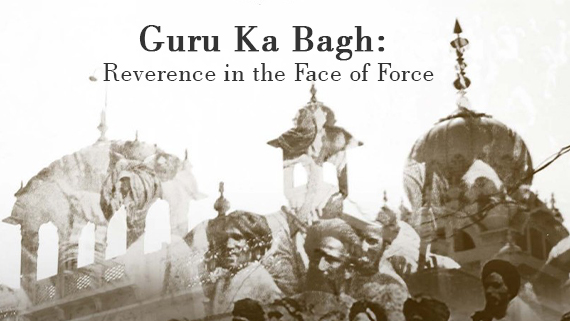
There are moments in history when silence becomes a roar.
When bowed heads become symbols of strength.
When prayer becomes resistance.
One such moment unfolded in the dust of Guru Ka Bagh, where bare feet met brutal batons, and still, the lips whispered Sabad, the Infinite Wisdom. Still, the heart remained immersed in Nam—Identification with the One.
This August marks the 100th commemoration of the Guru Ka Bagh Morcha—a century since that quiet storm of devotion and defiance unfolded. As we remember, we are not merely looking back; we are being asked to live forward, to understand how such a moment came to be.
During the 18th century, the Sikh community endured waves of persecution, dislocation, and systemic dismantling. In this vacuum, the management of many gurduaras (Sikh places of learning and worship) fell into the hands of Udasi mahants—landed caretakers who strayed far from Sikh principles, living lives of indulgence and aligning with colonial power structures. By the early 20th century, this decay had become too profound to ignore.
At Guru Ka Bagh, one such mahant, Sundar Das Udasi, resisted community efforts to restore the sanctity and self-governance of the gurduara space. His wealth, authority, and the backing of the British Raj made him a formidable opponent. But the Sikhs came not with swords, but with Sabad. Not with anger, but with Ardas—collective supplication.
What followed was extraordinary.
Day after day, unarmed Sikh jathas—organized Sikh bands walked toward Guru Ka Bagh, heads high, voices steady, hearts centered in Nam. They were met with brutal violence. Lathis (long, heavy sticks) struck their shoulders and spines. Boots crushed their backs. Yet they did not raise a hand. Not a word of defiance. Only prayer.
The world took notice.
A.L. Verges captured it on film.
Charles Freer Andrews bore witness with his pen.
He wrote of Akali Sikhs collapsing from beatings, only to rise again in silence, their lips moving in prayer. He called it a crucifixion in the shadow of the Cross. He called it true martyrdom.
We pause.
This was not passive suffering. It was intensely active spiritual resistance. The Guru Ka Bagh Morcha was not just a defense of land—it was a reclaiming of identity, of justice, of sanctity. It was the Sikh spirit manifest—undaunted, prayerful, resolute.
We reflect:
Do we remember Guru Ka Bagh with a sense of feeling, not just facts?
Do we hear the prayers behind the silence, the bruises borne without bitterness?
Are we willing to walk with that kind of humility when the world tells us to shout?
To protect what anchors us in remembrance—not just in our institutions, but in our hearts?
The Morcha reminds us that true sovereignty is not measured in territory, but in inner steadiness. That protest can be an offering. That the Guru’s way calls us to rise—again and again—not with fists clenched, but with hearts open.
Are we living this legacy?
Are we protecting our cherished spaces—from within and without?
Are we building institutions rooted in Nam and nourished by seva (service)?
And when the world presses in, will we respond with remembrance?
The echo of Guru Ka Bagh is not lost in time.
It lives in every bowed head that refuses to hate.
It lives in every step we take for justice with love.
It calls to us still—will we answer with the same grace?
May the Guru-Wisdom guide us!
Sikh Research Institute