Ottawa, Canada: The Canadian Security Intelligence Service (CSIS) released its Public Report 2024 on June 18, 2025. The report includes key sections addressing India’s foreign interference in Canada and Khalistan activism.
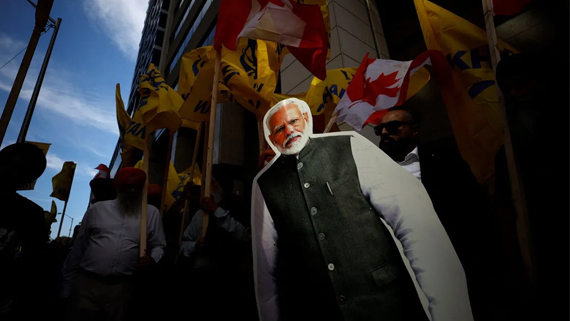
India’s foreign interference is detailed on pages 40 and 41 of the report, where the issue is also linked to concerns about Khalistan activism. Additionally, on page 44, Khalistan activism is discussed under the section titled “Politically Motivated Violent Extremism” (PMVE).
Below are verbatim excerpts from the CSIS Public Report 2024:
India
As PIFI began its first phase of public hearings in March 2024, the extent of the Government of India’s involvement in foreign interference became clearer. Indian officials, including their Canada-based proxy agents, engage in a range of activities that seek to influence Canadian communities and politicians. When these activities are deceptive, clandestine or threatening, they are deemed to be foreign interference. These activities attempt to steer Canada’s positions into alignment with India’s interests on key issues, particularly with respect to how the Indian government perceives Canada-based supporters of an independent homeland that they call Khalistan.
With the re-election of Indian Prime Minister Narendra Modi, India’s political course will be a continuation of a Hindu-nationalist policy agenda that has been implemented since Prime Minister Modi was first elected in 2014. Prime Minister Modi and his core ministers and advisers are keen to build India’s global influence and counter any activity they consider as ‘anti-India,’ at home or abroad, in the name of domestic stability and prosperity. With that considered, there is a long history of India arguing that Canada is a haven for ‘anti-India’ activity, with the separatist Khalistan movement being a particular focus of India’s concern, which is rooted in the aftermath of the 1985 Air India bombing and subsequent terrorist activity in India.
The Government of Canada’s investigation into the 2023 killing of Canadian citizen Hardeep Singh Nijjar continued in 2024. Four individuals were arrested in May 2024 and charged with first-degree murder and conspiracy to commit murder. Criminal proceedings are ongoing. In mid-October, as part of ongoing RCMP investigations, the RCMP announced that evidence pointed to a link between agents of the Government of India and criminal networks to sow violent activity in South Asian communities in Canada. On October 14, Canada, in the interests of public safety, expelled six Indian diplomats and consular officials in order to disrupt this network. Links between the Government of India and the Nijjar murder signals a significant escalation in India’s repression efforts against the Khalistan movement and a clear intent to target individuals in North America.
As PIFI reached the end of its public hearings and South Asian communities in Canada expressed concerns over Government of India pressure tactics and targeting, CSIS noted that this form of foreign interference, called transnational repression, plays a central role in India’s activity in Canada. Transnational repression is a well-established tactic for foreign governments to exploit communities they view as their ethnic populations. Canada must remain vigilant about continued foreign interference conducted by the Government of India, not only within ethnic, religious and cultural communities but also in Canada’s political system. CSIS will continue to observe and assess the nature and extent of India’s activities in Canada.
(Source: CSIS Public Report 2024, page 40-41)
Politically motivated violent extremism (PMVE)
Politically motivated violent extremism (PMVE) encourages the use of violence to establish new political systems or new structures or norms within existing systems. PMVE actors engage in the planning, financing and facilitating of attacks, globally, in order to establish new political systems or entities.
Since the mid-1980s, the PMVE threat in Canada has manifested primarily through Canada-based Khalistani extremists (CBKEs) seeking to use and support violent means to create an independent nation state called Khalistan, largely within Punjab, India.
Some Canadians participate in legitimate and peaceful campaigning to support the Khalistan movement. Non-violent advocacy for an independent state of Khalistan is not considered extremism. Only a small group of individuals are considered Khalistani extremists because they continue to use Canada as a base for the promotion, fundraising or planning of violence primarily in India. While there were no CBKE-related attacks in Canada in 2024, ongoing involvement in violent activities by CBKEs continues to pose a national security threat to Canada and Canadian interests. In particular, real and perceived Khalistani extremism emerging from Canada continues to drive Indian foreign interference activities in Canada.
(Source: CSIS Public Report 2024, page 44)
⊕ ALSO WATCH: Exclusive Talk with Canadian Sikh Activist Bhai Moninder Singh (Sikh Federation Canada)